Subterranean termite treatment in Cincinnati addresses the specific vulnerability of Southwestern Ohio architecture, where dense clay soils in Hamilton County retain subterranean moisture along stone, brick, and hollow…
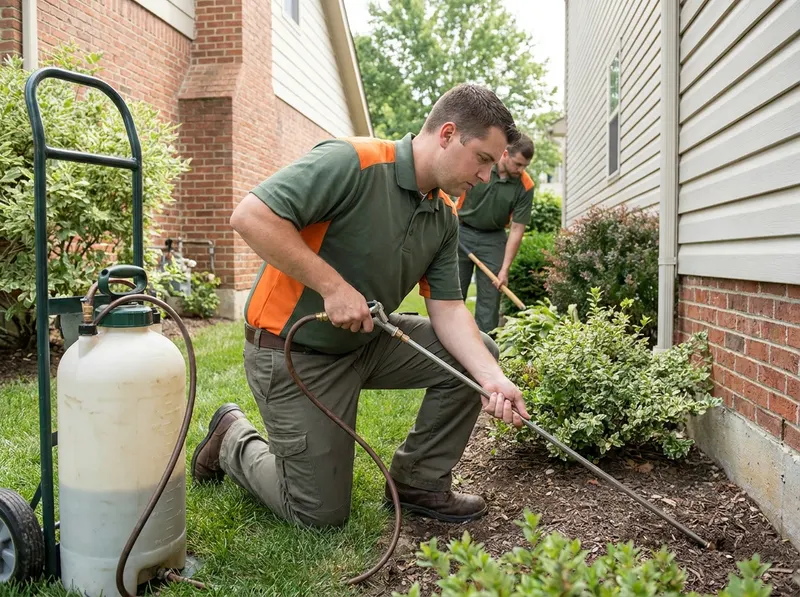
Subterranean termite treatment in Cincinnati addresses the specific vulnerability of Southwestern Ohio architecture, where dense clay soils in Hamilton County retain subterranean moisture along stone, brick, and hollow block foundations. The eastern subterranean termite nests deep beneath the frost line, moving upward through microscopic foundation cracks to consume structural cellulose, joists, and subfloors. Properties in historic districts like Over-the-Rhine, Mount Adams, and Clifton frequently possess rubble stone footings that demand liquid termiticide saturation along interior crawlspaces and exterior walls, whereas slab and basement designs in Hyde Park, Oakley, and Mount Lookout typically require precision perimeter trenching. Liquid non-repellent termiticides, such as fipronil formulations evaluated by the US Environmental Protection Agency, create an invisible barrier where worker termites unwittingly transfer the active lethal agent throughout the central nest via normal social grooming.
Selecting between continuous non-repellent liquid trenching and perimeter bait station installations depends entirely on building construction and site access. Liquid barriers deliver direct perimeter neutralization within days by continuous saturation 6 inches deep and 6 inches wide along foundation perimeters, adhering strictly to Ohio Department of Agriculture Pesticide Regulation standards. In contrast, properties situated near steep grades or sensitive root networks, such as those bordering Spring Grove Cemetery and Arboretum or Eden Park, benefit from targeted bait stations placed every 10 to 15 feet to intercept foragers before they bridge masonry voids. The trade-off centers on disruption versus eradication time: liquid trenching requires minor soil displacement or concrete drilling along patios but establishes continuous protection immediately, while bait systems maintain pristine turf integrity but demand multi-month colony interception schedules monitored under National Pest Management Association guidelines.
Step 1 involves an exhaustive foundation sounding and moisture meter evaluation across sills and band joists to map live galleries. Step 2 requires mechanical trenching alongside the exterior grade or sub-slab micro-drilling beneath basement floors. Step 3 introduces termiticide dispersion calibrated precisely at 4 gallons per 10 linear feet per foot of depth as specified by the Clemson University Department of Pesticide Regulation. Step 4 seals all exterior intervention points with hydraulic cement to match concrete surfaces. Step 5 institutes post-application monitoring across high-risk subterranean conduits near plumbing stacks and exterior earth-to-wood contacts, following protocols cataloged by the Entomological Society of America. Work near active commercial waterways or sites close to Great American Ball Park and Findlay Market adheres to environmental drainage guidelines outlined by the Cincinnati Health Department and the Ohio Environmental Protection Agency. Long-term property resilience relies on removing exterior mulch contact, maintaining downspout discharge 5 feet away from masonry footings, and aligning remediation directly with recommendations from the Ohio State University Extension, National Institute of Standards and Technology building performance research, and residential wood durability studies managed by the USDA Forest Products Laboratory. Contact DesertCrown Pest Services at (513) 812-8085 to confirm site variables.
Every job gets a firm, written price after an on-site visit.
Tell us about your subterranean termite treatment job in Cincinnati and we'll send a clear, written quote, usually the same day.
 DesertCrown Pest Services