Occasional invaders seek indoor refuge primarily during sharp atmospheric transitions in Hamilton County, particularly during early autumn cooling trends and prolonged summer humidity spikes. In historic neighborhoods…
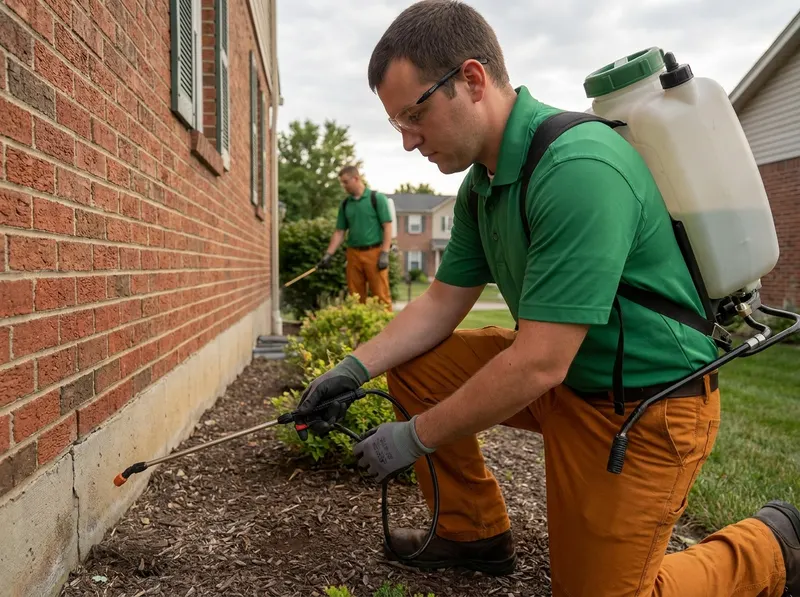
Occasional invaders seek indoor refuge primarily during sharp atmospheric transitions in Hamilton County, particularly during early autumn cooling trends and prolonged summer humidity spikes. In historic neighborhoods like Over-the-Rhine and Clifton, brick row houses and century-old stone foundations exhibit microscopic mortar voids that admit brown marmorated stink bugs, western conifer seed bugs, and millipedes seeking harborage against frost. Similarly, heavily wooded residential settings near Ault Park in Mount Lookout and Hyde Park frequently encounter heavy ground movements of camel crickets and house centipedes entering walk-out basements through aging door sweeps. Perimeter defense establishes an impermeable line of deterrence before nocturnal pests establish harborage inside wall voids, crawlspaces, or insulation blankets, eliminating the sleep disruption caused by scurrying insects.
The mechanical application relies on targeted formulations aligned with standards from the US EPA Integrated Pest Management program. Technicians apply a liquid residual barrier establishing a protective strip extending 3 feet horizontally away from the home and 3 feet vertically up the foundation wall. In neighborhoods such as Northside, Oakley, and College Hill, older residential architecture often features hollow block foundations or exterior framing sitting low to grade, requiring careful calibration around sub-slab heating ducts in accordance with CDC Healthy Homes Guidelines. DesertCrown Pest Services employs low-toxicity synthetic pyrethroids or botanical micro-emulsions verified by the National Pesticide Information Center to prevent hazardous environmental buildup while maintaining stability on damp concrete substrates.
Homeowners selecting between spot-treating indoor insects and applying an exterior boundary face a clear mechanical trade-off: indoor aerosols merely react to visible pests after floorboards and baseboards are already compromised, whereas exterior treatments actively stop the entry vector at the masonry boundary. In river-adjacent microclimates near Mount Adams, high moisture promotes rapid invertebrate reproduction; addressing these populations requires treating soil boundaries according to Ohio State University Extension pest biology data. The defense system integrates physical exclusion techniques, sealing exterior pipe penetrations using wire mesh rated under the ASTM International Standards. To preserve residential ecology, formulations avoid broad pollinator drift, aligning with Xerces Society Invertebrate Conservation recommendations and guidelines set by the Ohio Department of Agriculture Plant Health Division.
Implementing the defense protocol follows a structured physical progression across the exterior shell:
Properties located adjacent to heavy vegetation near the Cincinnati Zoo & Botanical Garden or Spring Grove Cemetery and Arboretum face intensified seasonal pressures. Maintaining this boundary provides proactive security without locking owners into perpetual quarterly billing traps.
Every job gets a firm, written price after an on-site visit.
Tell us about your occasional invader perimeter defense job in Cincinnati and we'll send a clear, written quote, usually the same day.
 DesertCrown Pest Services