DesertCrown Pest ServicesDesertCrown Pest Services

Flea and Tick Yard and Interior Mitigation Cincinnati

Flea and tick infestations in southwestern Ohio thrive due to humid river-valley conditions that foster biological reproduction in both interior textiles and dense outdoor foliage. A successful eradication protocol…
Get My Estimate →(513) 812-8085
Flea and Tick Yard and Interior Mitigation in Cincinnati, OH
Quick answer
  • Service scope: Interior crack-and-crevice barrier application, low-moisture carpet residual treatment, exterior perimeter banding, and outdoor vegetation barrier spraying up to 30 feet from the foundation.
  • Dispatch window: Scheduled arrival within 24 to 48 hours across Hamilton County, with immediate perimeter stabilization protocols.
  • Base investment: Starting pricing begins at the $200 minimum for small footprint lots under 1,500 square feet; exact investment confirmed on-site prior to application.
  • Targeted organisms: Ctenocephalides felis (cat flea), Ixodes scapularis (blacklegged deer tick), Dermacentor variabilis (American dog tick), and Amblyomma americanum (lone star tick).
  • Deployment step: Call (513) 812-8085 to schedule a site diagnostic and receive property preparation guidelines.

Flea and tick infestations in southwestern Ohio thrive due to humid river-valley conditions that foster biological reproduction in both interior textiles and dense outdoor foliage. A successful eradication protocol requires integrated pest management targeting both zones simultaneously. Treating only the interior leaves the structure vulnerable to re-infestation from wildlife corridors near public greenspaces like Cincinnati Parks, while treating only the perimeter leaves pupae dormant inside baseboards and carpet fibers. DesertCrown Pest Services deploys targeted perimeter defense with zero binding contracts, avoiding recurring monthly retainers by neutralizing nesting populations at the biological source.

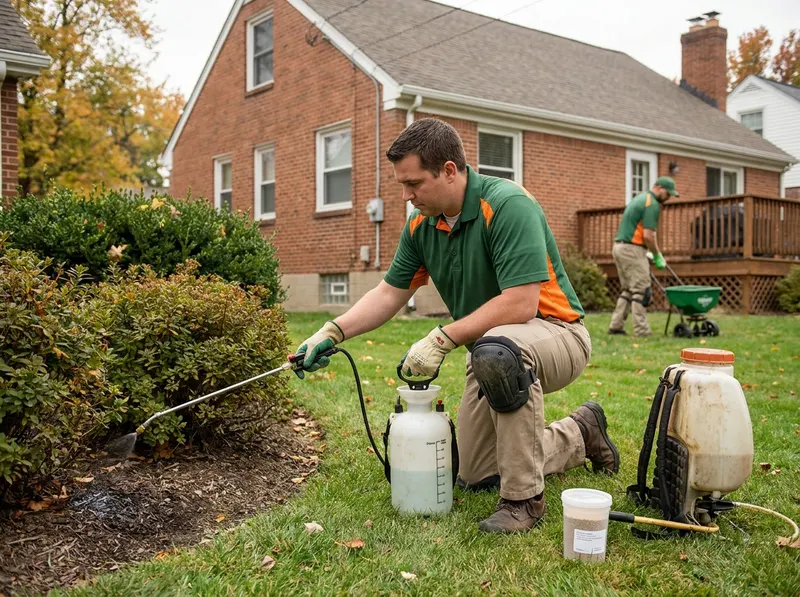
Outdoor protocols target the transition zones where native vectors operate. Properties in Northside, Clifton, and College Hill frequently encounter tick migrations transported by white-tailed deer and small rodents traversing overgrown ravines and wooden fence lines. Technicians apply a liquid microencapsulated adulticide combined with a botanical-derived juvenile hormone mimic along shaded perimeter turf, ornamental shrubs, and leaf litter. Interior protocols address the behavioral realities of flea larvae, which avoid light by burrowing into carpet backings, hardwood seams, and pet resting zones across older housing stock in Over-the-Rhine, Mount Adams, and Hyde Park. Applications adhere to structural pesticide safety guidelines outlined by the US Environmental Protection Agency and regulations enforced by the Ohio Department of Agriculture Pesticide Regulation division.

Achieving complete eradication involves a structured sequential protocol executed across five distinct operational phases:

  1. Step 1 Preparation: Occupants vacuum all floor surfaces thoroughly, launder pet bedding at a minimum of 130 degrees Fahrenheit, and vacate the treatment zones alongside domestic animals.
  2. Step 2 Diagnostic Survey: Technicians measure property boundaries, calculate interior square footage, identify moisture-dense tick resting sites, and document flea emergence hot spots.
  3. Step 3 Interior Disruption: Application of a targeted non-staining adulticide and an insect growth regulator to carpets, sub-furniture voids, and baseboard junctions.
  4. Step 4 Exterior Barrier Defense: Power-spraying a liquid barrier up to 30 feet outward from the foundation, focusing on shaded brush, crawl space vents, and property margins.
  5. Step 5 Post-Treatment Curing: Properties remain vacant for 2 to 4 hours until all wet liquid residues dry completely, eliminating chemical transfer risks to children and companion animals.

The primary mechanical trade-off in parasite control lies between immediate adult knockdown and pupal disruption. Adulticides deliver visible elimination within 2 to 4 hours, but flea pupae inside protective silk cocoons are impervious to direct chemical penetration. Emerging fleas contact the residual insect growth regulator over the subsequent 10 to 14 days, preventing viable egg development. Homeowners who skip the outdoor barrier face continuous vector reintroduction from urban wildlife traversing corridors near Cincinnati Zoo & Botanical Garden and wooded tracts adjacent to Spring Grove Cemetery and Arboretum. DesertCrown Pest Services operates under strict technical parameters consistent with the Centers for Disease Control and Prevention vector control science, utilizing active ingredients reviewed by the National Pesticide Information Center. Safety standards align with workplace application practices set by the Occupational Safety and Health Administration, while tick surveillance guidance reflects scientific research from the University of Rhode Island TickEncounter Resource Center and wildlife-parasite interaction monitoring published by the Ohio Department of Natural Resources and vector data tracked by the Ohio Department of Health. Reach the dispatch desk directly at Call (513) 812-8085.

How much does Flea and Tick Yard and Interior Mitigation cost in Cincinnati?

Urban Lot / Townhome (Interior up to 1,500 sq ft + Small Yard Perimeter)$200, $275
Mid-Size Single Family (Interior 1,501, 2,500 sq ft + Yard up to 0.25 Acre)$275, $375
Large Residence (Interior 2,501, 4,000 sq ft + Yard up to 0.50 Acre)$375, $525
Heavy Infestation Acreage (Structures 4,000+ sq ft + Yard up to 1.0 Acre)$525, $750

Every job gets a firm, written price after an on-site visit.

Common questions

How much does flea and tick yard and interior mitigation cost in Cincinnati?
Flea and tick yard and interior mitigation in Cincinnati starts at a base minimum of $200 for properties under 1,500 square feet, scaling up to $525 or more for lots reaching half an acre. Final exact pricing is confirmed on-site before chemical application begins.
How long must pets and children stay out of a Cincinnati home after treatment?
Occupants must remain out of the treated interior and exterior zones for 2 to 4 hours following application in Cincinnati. Liquid applications must dry entirely to ensure chemical bonds anchor to structural surfaces, preventing skin exposure or transfer.
Why are fleas still visible after an interior mitigation service in Cincinnati?
Newly emerged adult fleas remain visible for 7 to 14 days following treatment as dormant pupae hatch from protective cocoons that pesticides cannot penetrate. These newly hatched fleas absorb the residual insect growth regulator upon emergence and die before reproducing.
Does exterior tick mitigation in Cincinnati harm beneficial garden pollinators?
Exterior tick mitigation avoids flowering blooms and active pollinator patches by focusing applications on low shaded turf, dense groundcover, leaf litter, and woodpiles. This targeted perimeter placement reduces pesticide contact with honeybees and native foraging insects.
Do shaded properties in Cincinnati neighborhoods require different mitigation steps?
Shaded properties in Mount Lookout, Oakley, and Pleasant Ridge require broader outdoor treatment buffers due to persistent soil humidity that extends tick survival times. Technicians treat deeper into brush lines and shaded fence borders to disrupt tick hydration zones.

Get started today

Tell us about your flea and tick yard and interior mitigation job in Cincinnati and we'll send a clear, written quote, usually the same day.

Get your PEST CONTROL SEVICE quote, Cincinnati

We only use your ZIP to check availability, no spam.