DesertCrown Pest ServicesDesertCrown Pest Services

Ant Colony Elimination Cincinnati

Surface spraying with consumer aerosols often worsens indoor ant activity by triggering a biological survival response known as budding. When exposed to pyrethroid sprays, satellite colonies split off from the primary…
Get My Estimate →(513) 812-8085
Ant Colony Elimination in Cincinnati, OH
Quick answer
  • What is included: Species identification, moisture mapping, interior perimeter micro-gel baiting, and exterior non-repellent barrier application.
  • Dispatch timeframe: Technician dispatch within 24 to 48 hours across Hamilton County, with exact arrival windows.
  • Pricing baseline: Baseline colony extermination starts at $200, with final costs determined by colony maturity and nesting points.
  • Species handled: Odorous house ants, carpenter ants, pavement ants, and acrobat ants nested in foundations or structural timber.
  • Contact method: Telephone direct line dispatch at (513) 812-8085 for technical consultation.

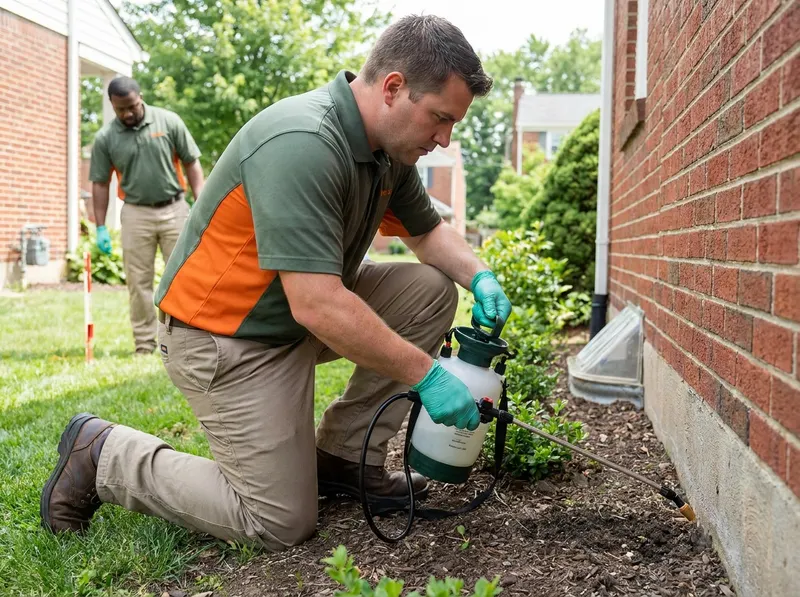
Surface spraying with consumer aerosols often worsens indoor ant activity by triggering a biological survival response known as budding. When exposed to pyrethroid sprays, satellite colonies split off from the primary reproductive queen, turning a localized kitchen issue into a multi-room intrusion across floor joists and wall voids. DesertCrown Pest Services implements targeted perimeter defense based on guidelines established by the US EPA Integrated Pest Management program. By deploying specialized non-repellent liquid barriers alongside slow-acting micro-gel matrices, foraging workers transport active ingredients back through the nest via social food sharing (trophallaxis). This delivery model eliminates the brood and queen deep inside structural cavities without aerosolizing synthetic compounds into living areas.

Cincinnati homes face varied infestation mechanics due to localized architectural styles and soil compositions across Hamilton County. Historic brick rowhouses in Over-the-Rhine and limestone foundations in Mount Adams frequently harbor deep-seated pavement ant (Tetramorium immigrans) networks beneath basement slabs. In contrast, heavily wooded residential parcels in Clifton, Hyde Park, Mount Lookout, and Northside experience frequent carpenter ant (Camponotus pennsylvanicus) infestations. Carpenter ants excavate moist, decaying framing near roof valleys or aging window sills rather than consuming wood fiber, requiring precise structural void injection. Species identification follows taxonomic protocols outlined by the Ohio State University Department of Entomology and the Entomological Society of America to match nutritional preferences (carbohydrate versus lipid seasons) to specific chemical baits.

Technicians conduct a methodical four-step intervention process during on-site deployment:

  1. Step 1 involves physical inspection and species identification using trailing diagnostics along foundation footers and plumbing chases.
  2. Step 2 utilizes mechanical void inspection and thermal moisture meters compliant with standards from the International Association of Certified Home Inspectors to isolate water leaks that sustain nesting cavities.
  3. Step 3 applies interior target-specific bait placements within crack-and-crevice junctions according to OSHA occupational safety standards.
  4. Step 4 seals exterior subterranean migration routes by laying a continuous non-repellent perimeter barrier along the exterior foundation perimeter.

All treatments adhere strictly to state pesticide application rules administered by the Ohio Department of Agriculture Pesticide Regulation and consumer safeguards detailed by the Federal Trade Commission. Moisture-damaged siding remediation standards parallel the preservation strategies defined by the National Park Service Preservation Technical Services for older structural frames in neighborhoods like College Hill and Pleasant Ridge. By treating the colony origin directly, ongoing structural wood decay is arrested without locking homeowners into perpetual service contracts. Homeowners can reach technical dispatch at (513) 812-8085 to confirm site inspections.

How much does Ant Colony Elimination cost in Cincinnati?

Single-Colony Interior/Exterior Targeted Treatment (Pavement/Odorous)$200 - $325
Structural Carpenter Ant Void Injection & Perimeter Barrier$350 - $550
Multi-Nest Complex Eradication (Historic Stone Foundation / Multi-Level)$450 - $750
Perimeter Botanical Barrier Maintenance Treatment (Non-Contract)$200 - $275

Every job gets a firm, written price after an on-site visit.

Common questions

How much does ant colony elimination cost in Cincinnati?
Ant colony elimination in Cincinnati starts at a minimum charge of $200 for single-point infestations, while complex carpenter ant infestations within historic foundations range between $350 and $750. An exact price is confirmed on-site before chemical application begins.
Why did spraying over-the-counter insecticide make ant numbers increase in my Cincinnati home?
Over-the-counter repellant sprays kill only visible worker ants on contact, triggering a colony defense mechanism called budding that causes the queen to disperse and create multiple satellite colonies. Effective elimination requires non-repellent bait chemistry that workers carry back to eradicate the central nest.
Are ant treatments safe around pets and children in Cincinnati households?
Professional bait applications are placed inside tamper-resistant stations or injected directly into inaccessible wall voids, eliminating direct exposure risks for children and pets. All formulations comply with structural pest handling regulations enforced by the National Pesticide Information Center.
How long does complete ant colony eradication take in Cincinnati conditions?
Complete colony eradication typically requires 7 to 21 days depending on nest depth and species biology. Because slow-acting non-repellents rely on social food transmission to reach the reproductive queen, foraging activity may visibly continue for several days before total nest collapse occurs.
Do carpenter ants cause structural framing damage to homes in Cincinnati?
Carpenter ants cause progressive structural damage by hollowing out smooth nesting galleries in damp wall framing, subfloors, and roof eaves. While they do not consume cellulose like termites, their excavation weakens load-bearing timbers if colonies remain untreated in moist Cincinnati basements or attics.

Get started today

Tell us about your ant colony elimination job in Cincinnati and we'll send a clear, written quote, usually the same day.

Get your PEST CONTROL SEVICE quote, Cincinnati

We only use your ZIP to check availability, no spam.